Tuesday, April 20, 2010

Fiery Pool: The Maya and the Mythic Sea

As a passionate Mayanist, I was delighted to discover that a nearby museum was having a exhibition on the Maya.

Fiery Pool: The Maya and the Mythic Sea is a new exhibit at the Peabody Essex Museum, (PEM) located on Essex St. in Salem Ma. As the Mayan civilization was surrounded by water, this exhibit makes a great connect between the Maya and the sea. And since the glyph of the "sea' was only translated in the late 1980's, our realization of the role of the sea is relatively fresh.


 Incense Burner, Deity with Aquatic Elements

I attended the exhibit at the Museum this past Monday. I had high hopes for it, and they were not only met but surpassed. The Museum has done a fantastic job with the layout of the 90 artifacts, spreading them out over 6 rooms, with nothing feeling cramped nor rushed. I asked Whitney Riepe, Senior Public Relations Associate at PEM why this exhibit was important.


"Fiery Pool presents exquisitely rendered and extremely rare examples of Maya art, many of which have never before been seen in the United States.  Beyond the aesthetic delight, this exhibition offers an entirely new interpretation of Maya cosmology based on cutting-edge research.  It's immersive, it's dramatic, and it's not to be missed!"

                                                                                                          Jade Sculpture of a Jester God 
As you enter the Exhibit, you are greeted by a 5 foot tall statue of the deity Cha'ak, (Chaac in some spellings), god of rain and storms.Around the corner is the first room, and like most  of the others is a mix of stone friezes, pottery, jewelry and figurines. The pieces are spread out, and supplemented by some simple audio visual effects. For example, in the first room several screens hang overhead with rolling storm clouds projected on them. There is also the sound of rain in the background.

This fantastic exhibit pulls you in and lets you  reflect on Mayan cosmology. It is kid friendly, with a nice guide for families to use as they tour the artifacts One fun feature is a oval stand, with a top that is a touch screen computer. Shadow like forms of fish swim around in it, and by touching them, the information about the fish, and what it symbolized to the Maya, pops up. A group of kids just before us spent a lot of time sharing the information about different types of fish with each other.

Below is an example of one of the surprising pieces in the collection. It is a lobster effigy from about 1550 AD, discovered in what is now Belize. The face peering out is just so unexpected.


I can whole heartedly recommend this to anyone with even a passing interest in the Maya, or any ancient civilization. The artifacts are excellent: I am use to seeing stelae, figurines and glyphs in the jungle, here they are whole, clean and easily observed. Below is an example of one of the vessels on display. Since most of the Mayan pieces I have observed tend to be dull red clay pieces, the craftsmanship and preservation of the collection is astounding to me.This piece shows the world turtle, and we will revisit this image next blog.


This is a great exhibit, I encourage you all to go see it!

In my next blog I will share more about the exhibit, and where the title, "Fiery Pool" come from.

THE FIERY POOL, THE MAYA AND THE MYTHIC SEA
PEABODY ESSEX MUSEUM
27 MARCH-18 JULY 2010
WWW.PEM.ORG


Sculpture of a Pelican


J.T. Turner, Mayanist


Thursday, April 8, 2010

The Sacred Tree

In my travels to Guatemala, a wonderful and favorite sight of mine is the ceiba tree. To the Mayans, the ceiba is a sacred tree. It incorporates the whole cosmos for the Maya. The underworld represented by the roots, the trunk being this world, and the branches are the heavens. Its low hanging branchs are a path through which a persons soul can ascend to the heavens. So to the Maya these marvelous trees are sacred, and to this day when land is cleared, a ceiba tree is often left standing. You can often see these magnificent trees standing alone in open fields.

We have been chatting about the Milky Way, and the many things the Mayans saw in it. But in addition to a ball court or a crocodile, the Milky Way is also the World Tree.

In the Popul Vuh, the World Tree is mentioned as the origin of all life, with the 4 cardinal directions spreading out from it's center.(Many other ancient cultures have a World Tree as a part of their creation tradition). We can think of the great tree as soaring above us, the Milky Way being it's branches. In some legends, there is a great monster in the tree, it's mouth being the Dark Rift. In other versions, the trunk of the ceiba is actually a crocodile, (like a croc, the cieba has rough skin, with thorns found along it's trunk), and its mouth is the Drak rift high in the sky. With a bit of imagination, it is easy to see how the Mayans view the great Milky Way as the collective branches of the tree.


A major element of the World Tree includes the Kawak Monster, a giant head with a kin (symbol) in its forehead.  A bowl on its head contains a flint blade representing sacrifice, and  death.On top of the World Tree we find a bird that has been called, the Principal Bird deity, or Itzam Ye. During the months of winter, when the so-called "Winter" Milky Way dominates the sky, it was called the "White Boned Serpent."  


Soon I will start to pull this symbology together with the Mayan calendar, time and the doomsday. But first I will be spending the next few blogs talking about a new exhibit at the Peabody Essex Museum, which is about the Mayans, and their connection to the sea.


J.T. Turner
Mayanist

Friday, April 2, 2010

The Crocodile in a Tree

Glyph of the sky


Last blog I mentioned that to the ancient Maya, the Milky Way represented a great ball court in the sky. It links back to the creation tales of the Hero Twins. But to the Maya, the Milky Way represented several other things.For example, it was also seen as a great Crocodile, ( or in some translation, a Jaguar/Toad animal).. And the Dark Rift in the Milky Way was called the "mouth of the crocodile". It is often referred to as Hunab Ku, the center of the galaxy.And it is also referred to as xibalba be, the road to the underworld. Passage through the mouth of the crocodile then, was passage to the underworld of the Maya.


(In other cultures, it is viewed as a great serpent eating it's own tail. the Ourobus. And the ancient Greeks looked upon the time cycle displayed by the Milky Way and the Dark Rift as indicating the end of an age, as the Maya did).


The K'iche called this portion of the Milky Way "The Crossroads". They believed that when a planet, or the sun or the moon lined up in the center of the Rift, (in Sagittarius), that it was possible to cross from our world to the Underworld. This spot in the sky happens to be th Galactic Equator, or the center of the Milky Way. And this is key in our Doomsday discussion, as when a planet, sun or moon lines up, a journeyer can pass from our would to another. According to popular theory, on 12/21/12, there is a Galactic Alignment. The Galactic Alignment is the alignment of the December solstice sun with the Galactic equator. This is a rare event occurring on 25,800 years.


Let us appreciate that the Mayan's could find the dead center of the Universe. Truly they were an ancient civilization with amazing comprehension of time and space.


But the key consideration of the Milky Way is the concept that it is the World Tree of the Maya. Indeed the Crocodile symbolism is often called the Crocodile Tree. This is very similar to the World Tree concept that also contains a "monster' in it's branches. So next post, we will look at what the cieba tree means to the Mayans, and then we will look at the World Tree as seen in the Milky Way.


J.T. Turner, Mayanist

Wednesday, March 24, 2010

The Great Road in the Sky


Hello loyal readers! When last we met, I mentioned that I would show you a ball court, or at least where to find one...

Come outside with me. Yes, yes I know it is the dead of night, trust me it will be worth it. We need the right spot, preferably away from light pollution, outside of cities, as far into the countryside as we can get. Out here away from the glare we can see the stars better.  I want you to look up, and see not just the single stars, but a dense dusting of stars, like a path of spilled milk across the sky. That is the Milky Way. And this amazing sight is the key to a lot of what all the doomsday fuss is all about.

 
Astronomers would tell us that this amazing visual treat is actually a part of the very galaxy our earth is located in. The Milky Way galaxy is called a spiral galaxy, having arms that spiral out from it's center. Earth is on one of the edges of the galaxy, which contains between 200-400 billion stars. It is large beyond belief, 150,000 light years across. Light travels 5,880,000,000,000 miles per year, multiply that by 150,000 and you get the idea, the Milky Way is immense. It is roughly like a flying saucer, with a bulge at its center, and like all Galaxy's is filled with dust, stars and gas. Since we live on an edge, we look across this Galaxy, and that creates the milky road we can see going across the sky. This astronomical feature has had great effect on many of the ancient cultures of the world, especially upon the Mayans.Please note that within it is a dark spot, an opening if you will, called the Dark Rift. To the Mayans the Milky Way and the Dark Rift was several things, including the ball court we spoke of last blog.


Mayans were rather famous for thier ball games. Competing tems played on a ballcourt, trying to get points by driving a ball through a stone ring suspended in the court. So far as we know it was a bit like soccer, no hands were used just the rest of the body. Most famously the losing teams captain was sacrificed to the gods.
Mayan ballcourts were recatngular, had some slanted walls on the sides. Thinking of that shape we can superimpose the structure on the Milky Way, and imagine the Dark Rift as the goal circle.But the Dark Rift, as goal post, is also the entrance to the underworld, called xibalba. We know that the Hero Twins and their Father and Uncle before them, played against the gods in a ball court, and so the Mayans saw this in the night sky. This is a strong connection between astronomy and religion.

I know it is a stretch for us to see a ball court there in the Milky Way, but no more a strecth than seen a hunter, a dipper or a bear. But the Milky Way is more than just a ball court, more on it next blog.

Sunday, March 14, 2010

The Ball Game


                                                        Part of the ball court at Iximche


I have mentioned that the Hero Twins, as well as their Father and Uncle, played the notorious Mayan Ball game. We know less about this game than we do about the Aztec version, but we can make some good guesses. This serves as some background to the astronomical impact of 2012. To recap the legendary portion of the story,

"As the tale goes, the Maize Gods were avid ballplayers who were killed and buried on the court by the Lords of Xibalba (the Underworld) for bothering them with the noise of the game. The head of one of the Maize gods was hung from a tree in the Underworld, and as a daughter of the Lord of the Underworld passes, it spit into her palm, miraculously impregnating her. The daughter bore twin sons, the Hero Twins, who avenge their father and uncle’s deaths by resurrecting them on the ballcourt. The Hero Twins go on to survive the ordeals of Hell presented to them by the death gods, while the reborn Maize Gods remain on the ballcourt for humans to honor. The Maya therefore believed that it was necessary to play the game for their own survival. The ballgame provided an opportunity to show devoutness to the gods by sacrificing captured kings and high lords, or the losing opponents of the game."- William Palmer III Collection, University of Maine Orono

The game was called Pitz, (the actual playing called Ti Pitziil in Classic Maya and Chaaj in K'ich'é ), and had a key role in religious, social and political life. The Ball Court was usually in the great plaza of the city, and was considered a focal point. The Court was in the shape of an "I", with high platforms on each long side, allowing many people to view the game. A solid rubber ball was used, ranging in size from a grapefruit to a melon. The goal was to bounce the ball through stone hoops that hung on the sides of the court. The walls were painted with murals of myths, captives, Kings and animals. There were also movable stone markers (hachas) along the Court, usually depicting animals or skulls.


A movable stone marker


Players were not allowed to touch the ball with their hands, but used the rest of their bodies to keep it in the air, as the ball was not allowed to touch the ground during play. Players wore protective clothing as the ball weighed up to 20 pounds. They also used handstones called manopla to strike the ball.


Like modern ball games, Pitz was played by everyone including women and children. But the Mayans also had major games, often to settle disputes between cities, and captives were often forced to play. There is some evidence that the team leader of the losing team was killed, but that is a rather murky fact. The site authenticmaya.com tells us: The game between competing teams of players could symbolize the battles between the gods in the sky and the lords of the underworld. The ball could symbolize the sun. In some of these ritual games, the leader of the losing team would be decapitated, and  His skull would then be used as the core around which a new rubber ball would be made.  A common interpretation would emphasize the Venus cycle and the Maize God death-and-resurrection myth as core religious aspects of the game. The ancient Maya are believed to reenact, through the ball game, the mythic Underworld contest between the gods of life or fertility and the gods of death. 


Part of the Ball Court at Tikal


But you need not travel to Guatemala nor Mexico to see a Ball Court. Next post, I will tell you where you can find one......


J.T. Turner, Mayanist

Tuesday, March 9, 2010

Popul Vuh

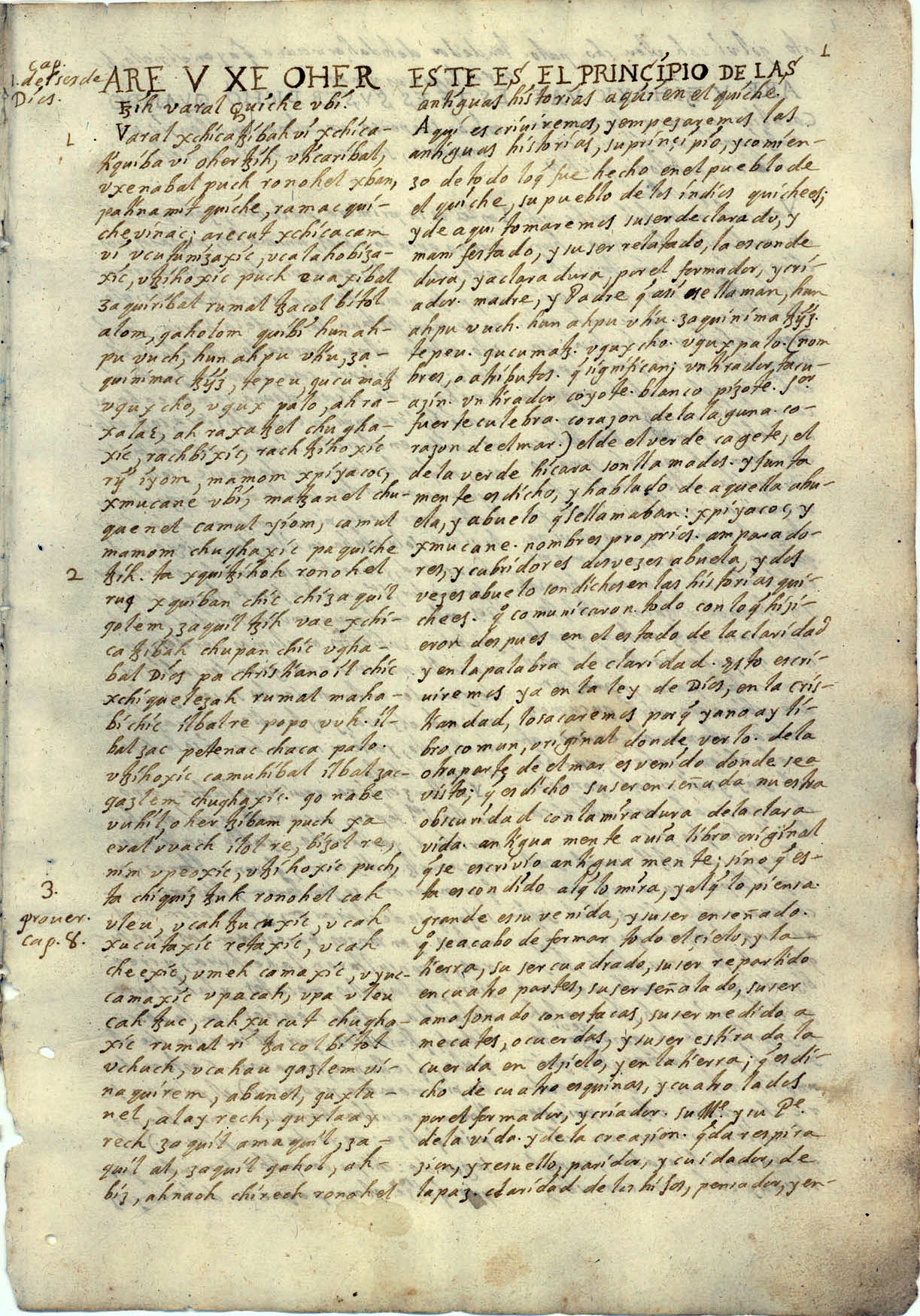
File:Popol vuh.jpgAn original page from the Popol Vuh Translation, about 1701

As we discuss the Maya, and the Doomsday Date of 12/21/2012, it makes sense to touch on an important book, the Popul Vuh.

Much of what we know about the Mayan creation theory/myth come to us from this book. When the Spanish invaded the Mayan Kingdoms, many of the Mayan books were burned as a part of the process to convert them to Catholicism.The books were considered pagan in nature, and so tragically destroyed. One book that was destroyed was called the Popul Vuh. It gave the mythistory (yes, that is a word) of the Quiche Kingdom in the Guatemalan Highlands. It is known that most other Kingdoms shared this book's beliefs. But didn't I say it was destroyed? Yes, it was, but a Quiche convert to Catholicism recreated it in Spanish, and it was transcribed and translated by a Dominican, Francis Ximenez.  .

A literal translation of Popul Vuh is "book of the mat", as the original was made of tree bark. But the general translation is accepted as "Book of the Community or Council". It has the stories of the creation of the world, and of man. Also the story of the "Hero-Twins" Hunahpu and Xbalanque, who play a major role in the creation myth. They were ballplayers, as were their Father,  Hun Hunahpu, and Uncle, Vucub Hunahpu, before them.


File:Izapa stela25.jpgThe Twins shooting a Bird Deity

Summoned to Xibalba, the Underworld, for playing ball too loudly, (oh shades of my own youth!), by the Lords of the Underworld, the father and uncle were defeated by one of the Lords' tests and sacrificed and Hun Hunahpu's skull was suspended in a trophy tree. When the daughter of one of the lords of Xibalba, approached this tree, the skull spat into her hand and thereby made her pregnant with the Hero Twins. The Twins grew up to avenge their father, and after many trials, finally defeated the lords of the Underworld in a ballgame. The Popol Vuh features other episodes involving the Twins as well (see below), including the liquidation of a pretentious bird demon, Vucub-Caquix, and of his two demonical sons. The Twins also removed their half-brothers from the scene, turning them into Howler Monkeys who were the patrons of artists and scribes. The Twins' final transformation into sun and moon establishes a metaphor for rule over earth and sky.


OK, so who cares? Well as we consider Mayan myths, the Hero Twins come into play again and again, and show how important Ball playing was in Mayan society. And when we discuss the Doomsday Date, the Ball Court plays an important role.

I should also mention that the Popol Vuh gives genealogies of the gods and the eventual rulers of Quiche. Of course many other kingdoms may have had variations in the legends, but based on various stone carvings, we know they were all similar to what we read in the Popul Vuh.

Next Up, The Mayan Cosmos.

J.T. Turner
Mayanist